

The Existential Toolkit for Climate Justice Educators
An easy-to-use field guide for teaching on climate injustice and building resilience in your students—and yourself—in an age of crisis.
“This book is destined to become a well-worn field guide for environmental educators worldwide, and the need for it at this time can’t be overstated. Educators who are daunted by their students’ climate anxiety, despair, or outrage, and instructors who feel like throwing up their hands at the complexity of what it means to teach well in the polycrisis, will find many of their concerns addressed in this volume. Much more than a book about trauma-informed climate education (though it is also that), this is a mind-expanding read about justice, decolonization, and imagination, chock full of pedagogical interventions you can try in the classroom.”
— Britt Wray, author of Generation Dread and Director of CIRCLE (Community-minded Interventions for Resilience, Climate Leadership, and Emotional wellbeing) at Stanford Psychiatry
Featuring insights from scholars, educators, activists, artists, game designers, and others who are integrating emotional wisdom into climate justice education, this user-friendly guide offers a robust menu of interdisciplinary, plug-and-play teaching strategies, lesson plans, and activities to support student transformation and build resilience.
“This wide-ranging volume provides topics, perspectives, and tools to help educators in the vital project of teaching climate justice. It highlights the need to attend to social inequities and emphasizes the important role of emotions in enabling resilience and resistance in the face of climate change.”
— Susan Clayton, developer of the Climate Change Anxiety Scale
Galvanizing and practical, The Existential Toolkit for Climate Justice Educators will equip both educators and their students with tools for advancing climate justice.
Support your local bookstore or purchase here.
Learn more about the book and explore online resources here.
Listen to this podcast review of the book on the Climate Change & Happiness Podcast
Listen to this interview on Yeah, I Got an F#%*ing Job With a Liberal Arts Degree Podcast.
A Field Guide to Climate Anxiety: How to Keep Your Cool on a Warming Planet
Drawing on a decade of experience leading and teaching in college environmental studies programs, Sarah Jaquette Ray has created an “existential tool kit” for the climate generation. Combining insights from psychology, sociology, social movements, mindfulness, and the environmental humanities, Ray explains why and how we need to let go of eco-guilt, resist burnout, and cultivate resilience while advocating for climate justice. A Field Guide to Climate Anxiety is the essential guidebook for the climate generation—and perhaps the rest of us—as we confront the greatest environmental threat of our time.
Available for purchase here. Scholarly Reviews: Arne Harms, in the World Medical and Health Policy Journal & Blanche Verlie, in the Australian Journal of Environmental Education

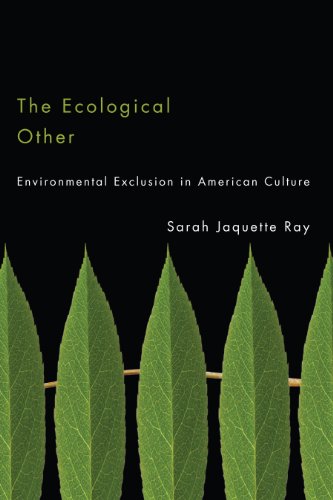
The Ecological Other: Environmental Exclusion in American Culture
With roots in eugenics and other social-control programs, modern American environmentalism is not always as progressive as we would like to think. In The Ecological Other, Sarah Jaquette Ray examines the ways in which environmentalism can create social injustice through discourses of the body.
The book challenges long-standing assumptions in environmentalism and will be of interest to those in environmental literature and history, American studies, disability studies, and Native American studies, as well as anyone concerned with issues of environmental justice. Purchase here.
Edited by Sarah
Disability Studies and the Environmental Humanities: Toward and Eco-Crip Theory
Although scholars in the environmental humanities have been exploring the dichotomy between “wild” and “built” environments for several years, few have focused on the field of disability studies, a discipline that enlists the contingency between environments and bodies as a foundation of its scholarship. On the other hand, scholars in disability studies have demonstrated the ways in which the built environment privileges some bodies and minds over others, yet they have rarely examined the ways in which toxic environments engender chronic illness and disability or how environmental illnesses disrupt dominant paradigms for scrutinizing “disability.”
Designed as a reader for undergraduate and graduate courses, Disability Studies and the Environmental Humanities employs interdisciplinary perspectives to examine such issues as slow violence, imperialism, race, toxicity, eco-sickness, the body in environmental justice, ableism, and other topics. With a historical scope spanning the seventeenth century to the present, this collection not only presents the foundational documents informing this intersection of fields but also showcases the most current work, making it an indispensable reference. Purchase here.
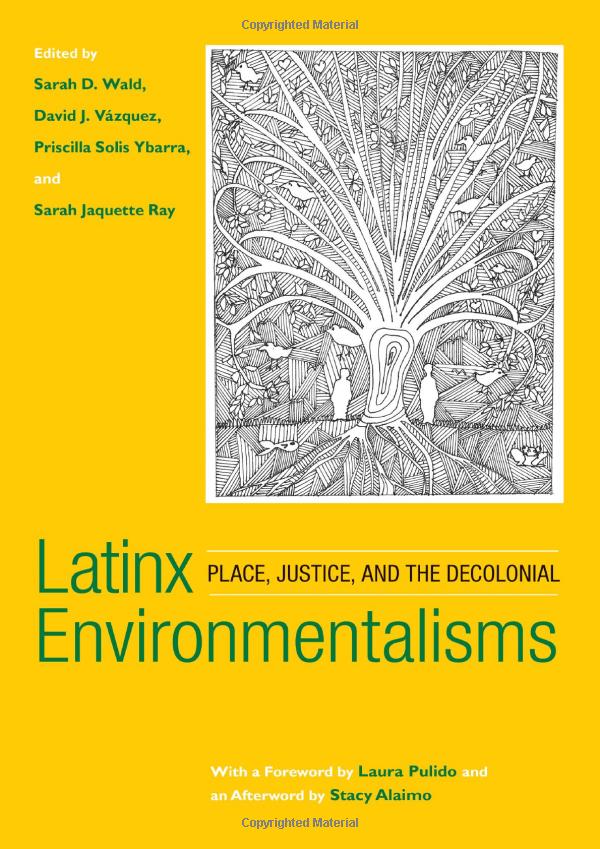
Latinx Environmentalisms: Place, Justice and the Decolonial
The whiteness of mainstream environmentalism often fails to account for the richness and variety of Latinx environmental thought. Building on insights of environmental justice scholarship as well as critical race and ethnic studies, the editors and contributors to Latinx Environmentalisms map the ways Latinx cultural texts integrate environmental concerns with questions of social and political justice.
Original interviews with creative writers, including Cherríe Moraga, Helena María Viramontes, and Héctor Tobar, as well as new essays by noted scholars of Latinx literature and culture, show how Latinx authors and cultural producers express environmental concerns in their work. These chapters, which focus on film, visual art, and literature—and engage in fields such as disability studies, animal studies, and queer studies—emphasize the role of racial capitalism in shaping human relationships to the more-than-human world and reveal a vibrant tradition of Latinx decolonial environmentalism.
Latinx Environmentalisms accounts for the ways Latinx cultures are environmental, but often do not assume the mantle of “environmentalism.” Purchase here.
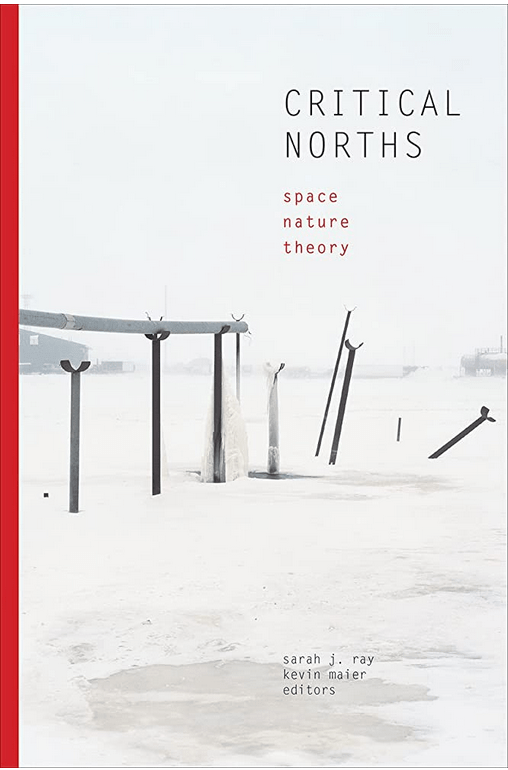
Criticial Norths: Space, Nature, Theory
For millennia, “the North” has held a powerful sway in Western culture. Long seen through contradictions—empty of life yet full of promise, populated by indigenous communities yet ripe for conquest, pristine yet marked by a long human history—it has moved to the foreground of contemporary life as the most dramatic stage for the reality of climate change.
This book brings together scholars from a range of disciplines to ask key questions about the North and how we’ve conceived it—and how conceiving of it in those terms has caused us to fail the region’s human and nonhuman life. Engaging questions of space, place, indigeneity, identity, nature, the environment, justice, narrative, history, and more, it offers a crucial starting point for an essential rethinking of both the idea and the reality of the North.
 Sarah Jaquette Ray