
In her new podcast, Environmental Studies professor and author Sarah Ray will explore the emotional life of climate politics. She’ll unpack the big and small questions about how we feel about climate change: what happens to your own mental health when you’re proactive about climate solutions? What do we know about PTSD for wildfire survivors? What exactly is climate anxiety, and how can someone get past it? What’s Gen Z got to say about it all?
Find episode details and where to listen here.
Sarah collaborates with the Climate Psychology Alliance of North America to put on events such as “Unnaming Climate: Authoritarianism, Collective Trauma, and Imperfect Solidarity” and “When Climate Anxiety Leans Right: Eco-fascism, Buffalo, & Roe“
Cancelled due to federal cuts to NSF research
Re-presenting population science data in the context of shifting demographic dynamics, climate change and conspiratorial epistemology Project
The project, led by Rajani Bhatia and Anne Hendrixson, will challenge the mainstreaming of “great replacement” conspiratorial nativism, white supremacism, xenophobia, and the eco-fascist violence they support in the US. Rather than dismissing Far Right ideology as pseudoscience, the project questions seek to understand how nativisms rationalize their ideologies using “partial truths” and scientific data. Relatedly, the project queries the role of population and climate sciences in perpetuating demographic anxiety and alarm that provokes racist, sexist, and nativist responses. The project seeks to challenge white supremacist ideas of what it means to be “native” in the United States, neo-Malthusian ideas of population-driven scarcity, and false notions of fertility and migration as the drivers of environmental degradation and climate change. With the research on the “great replacement” and eco-fascism in the US, the project will produce a scholarly book and freely available, interdisciplinary teaching tools for undergraduates. Sarah will serve on the advisory committee. Learn more about the grant here.


The Climate Wisdom Lab is a professional development offering for higher education institutions designed to support institutional efforts to prepare students for sustainable engagement with climate change, structural oppression and inequality, and other systemic challenges.
Cultivating the Climate Mind with Sarah Jaquette Ray
This series, in collaboration with Pacific Mindfulness, weaves together the most current research on mindfulness and climate change, social justice principles of collective resilience, and guided meditation to explore the role of equanimity, attention, compassion, joy, and purpose in the polycrisis. In each session, we will balance learning, listening, and practice as we find ballast together. See link for upcoming classes.


Sarah is on the Education team to support the UC Center for Climate Justice build curriculum, such as the MOOC we built to advance climate justice education throughout California higher educationi system” The mission of the University of California’s Center for Climate Justice’s Education program is to work with a new generation of climate justice changemakers, empowering them to address climate change from an equity and systems change perspective. Visit the Center here.
The Climate, Justice, and the Politics of Emotion Symposium took place at the University of California, Riverside on April 27-28, 2023. Organized by Dr. Jade Sasser, Dr. Blanche Verlie, & Dr. Sarah Jaquette Ray. This symposium brought these conversations out of the domain of the personal and private, as they both reflect and shape the very public and political arenas of climate change and social justice.Learn more about the program here.


Rachel Carson Center for Environmental & Society: “An Existential Toolkit for Climate Educators,” workshop In July, 2020, with Elin Kelsey and Jennifer Atkinson, I co-convened a pedagogy workshop with educators from around the world to share best practices for teaching in times of crisis and coping with climate change anxiety and dread. The gathering seeks to build on the momentum and work begun at RCC’s 2017 workshop on Radical Hope: Inspiring Sustainability Transformations through Our Past and “Beyond Doom and Gloom,” the RCC Perspectives publication edited by Elin Kelsey. While the collaborations at RCC that led to these resources explored ways to encourage hope for the future and foster human resilience in the face of environmental degradation, our 2020 workshop will explicitly take up problems in teaching. International Workshop hosted by the Rachel Carson Center, including a roundtable and 33 “Lightning videos” by educators, here.
Fire Adapted Communities Learning network
The Fire Adapted Communities Learning Network launched a quarterly book club to support peer learning, connection and skill building among our members and those working in domains relevant to our purpose of increasing community resilience and improving fire outcomes across the US. They are identifying books that are “fire adjacent,” (covering resilience, connection to place, culture change, natural process management, social science, etc). They have selected “A Field Guide to Climate Anxiety” as the inaugural book to feature in their book club. Learn more here.
UC-CSU Knowledge Action Network for Transformative Climate Education and ActioN
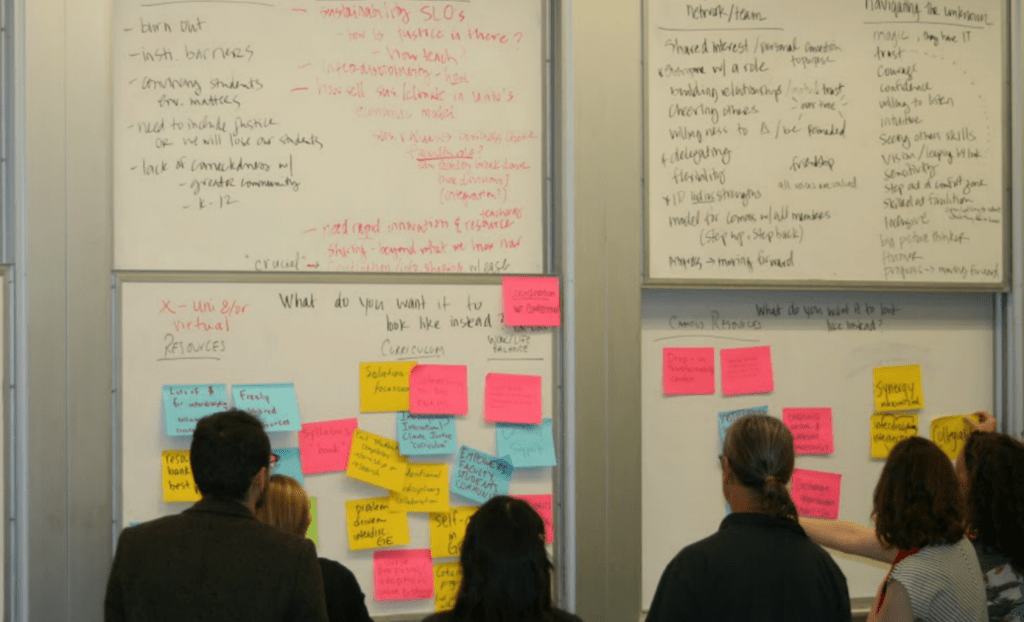
In 2016-17, Sarah served as the CSU leader of the UC-CSU Knowledge Action Network for Transformative Climate and Sustainability Education and Action, a collaborative effort of University of California and California State University educators to scale and intensify California students’ literacy in climate change, climate justice, carbon neutrality/greenhouse gas emissions reductions, and sustainability. Both the UC system and CSU system have placed great emphasis on sustainability education, community engaged scholarship, and carbon neutrality in recent years, and this project seeks to merge those efforts for the mutual advantage of California students. By design, strategy informing the network’s process is emergent and dependent upon collaboration, from both UC and CSU faculty. Area teams participated in a culminating virtual conference and Knowledge Action Network summary report to mobilize the network into collaborative action, which can be viewed here.

XTerra: Transformative Education for Climate Action
In 2018-2019, Sarah was the CSU lead, along with John Foran (UCSB, Sociology) and Richard Widick (UCSB, Orfalea Center for Global and International Studies) to extend the KAN’s work to develop a website of resources for teaching climate change and sustainability. UC-CSU NXTerra is a Knowledge-Action Network (KAN) and digital platform for climate educators, developed by faculty from the University of California (UC) and California State University (CSU) systems. A group of 13 University of California and California State University-based educators curated our best interdisciplinary, open access teaching resources on NXTerra. NXTerra produces, curates, and delivers climate change, critical sustainability, and climate justice education resources for teachers and students of every discipline—from the arts and humanities to the human and social sciences and the natural sciences—with the aim of sharing resources to accelerate climate education and action in California and beyond.
Big Planet Big Feels Podcast
The idea for this podcast came about in 2015, while we were discussing the seemingly infinite ways in which dread and despair over the state of the world had taken hold of us, personally, and also our community of colleagues, peers, students, and friends in the Environmental Studies program at Humboldt State University. Madi graduated from the program in 2018 and Sarah teaches in and runs the program. Over the years, we had a lot of conversations in class and outside of class about the need for more existential support for students learning about—and often experiencing first-hand—the effects of climate change and environmental injustice. Sarah’s research has moved in the direction of thinking more about the emotional dimensions of climate injustice, especially for what might be called “the climate generation” in the U.S. and Madi works to integrate these existential questions into her life as a farmer-philosopher in rural Vermont. Join us as we explore experiences of eco-grief and other emotions in a white supremacist-capitalist-patriarchal- climate-changed world through a series of interviews with eco-grievers of various sorts: youth, artists, educators, direct action activists, policymakers, psychologists, scientists, journalists, and more. Adapting to climate change is an emotional endeavor. We welcome each of you to listen and thank you for joining us in these dialogues. Subscribe & support at www.patreon.com/bigplanetbigfeels.

 Sarah Jaquette Ray